Dermal Fillers vs PDRN: Which Is Better for Your Skin?
Volume or skin quality? Two popular injectables, two very different jobs. Here is how to tell which one fits your concern.
When it comes to facial rejuvenation, two treatments increasingly part of the conversation are dermal fillers and PDRN. But which one is better for your skin?
The answer isn't as simple as choosing one over the other. Dermal fillers and PDRN are designed to address different aspects of facial ageing. Fillers are primarily used to restore lost volume, enhance facial contours and soften certain folds, while PDRN is used with the goal of supporting skin quality, repair and regenerative processes.
So if you're considering an injectable treatment, the more useful question may not be “Which treatment is better?” but “Which treatment is better suited to my specific concern?”
In this guide, we look at the key differences between dermal fillers vs PDRN, when each may be considered, and whether a combination approach can make sense for certain patients.

What Are Dermal Fillers?
Dermal fillers are injectable products used to add volume, restore contours and soften the appearance of certain facial lines and folds.
Many commonly used fillers are based on hyaluronic acid (HA), a substance naturally found in the body. Depending on the product and treatment area, fillers can enhance or restore volume in areas such as the lips, cheeks and chin, and address selected wrinkles, folds and contour concerns.1
Fillers may be considered for:
- Loss of cheek volume
- Lip volume and definition
- Chin enhancement
- Certain facial folds and lines
- Facial contouring
- Selected acne-scar or contour concerns
The key point is that fillers provide a structural and volumising effect. Think of them as a tool for addressing “where volume or support has been lost.”
What Is PDRN?
PDRN stands for polydeoxyribonucleotide. It is a DNA-derived biopolymer that has gained attention in regenerative dermatology and aesthetic medicine. Research suggests that it may support processes involved in tissue repair and regeneration.
In aesthetic medicine, PDRN and related polynucleotide treatments are being studied for their potential to improve aspects of skin quality, including texture, elasticity, hydration and the appearance of fine lines.2
Recent reviews have found promising results, but they also highlight an important point: the clinical evidence is still developing, with relatively small studies, variation in treatment protocols and limited consensus about the optimal indications and techniques.3
PDRN may be considered when the focus is on:
- Skin quality
- Fine lines
- Texture
- Elasticity
- Hydration
- Skin recovery and repair
- Certain scar-related concerns
Think of PDRN as a treatment focused on skin quality and regenerative goals, rather than one that creates the same volumising effect as a conventional dermal filler.
Dermal Fillers vs PDRN: What's the Difference?
The simplest way to understand it: fillers primarily address volume and structure. PDRN primarily targets skin quality and regenerative processes.
| Dermal Fillers | PDRN | |
|---|---|---|
| Primary focus | Volume and structure | Skin quality and regeneration |
| Adds facial volume | Yes | Not its primary purpose |
| Facial contouring | Yes | No |
| Skin texture | May improve appearance indirectly | One of the treatment goals |
| Fine lines | Can soften selected lines | May improve fine lines and skin quality |
| Elasticity | Secondary consideration | Potential treatment goal |
| Results | Often visible relatively quickly | Generally progressive |
| Best suited to | Volume loss and contour concerns | Skin-quality concerns |
This is why asking “Which is better?” without identifying the underlying concern can be misleading.
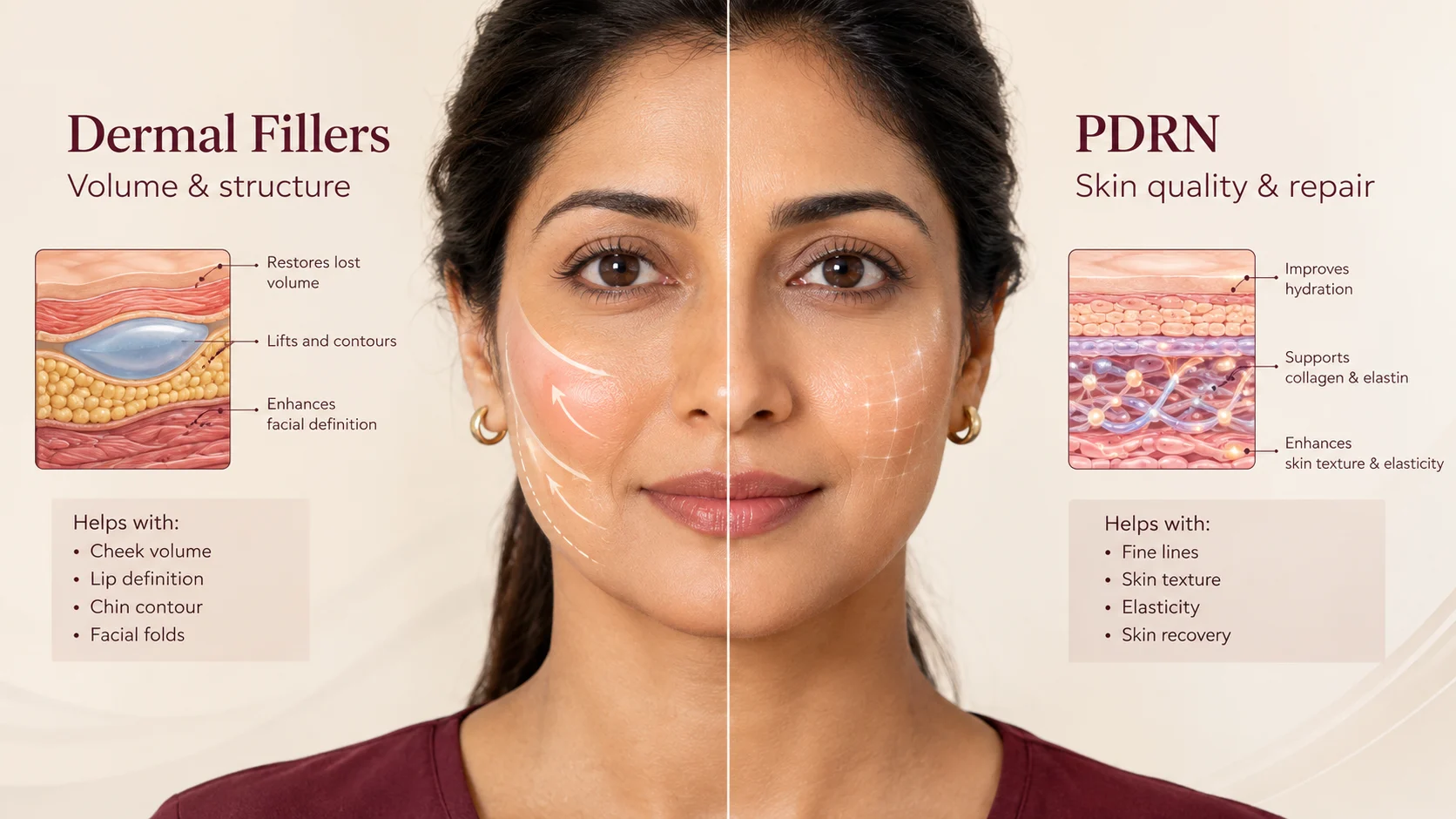
When Might Dermal Fillers Be the Right Choice?
A filler may be considered when the primary concern involves loss of volume, facial proportions or contour.
Loss of cheek volume
As the face ages, changes in soft tissue volume and structure can alter facial contours. Carefully placed filler can restore selected areas of volume.
Lip enhancement
When the goal is more lip volume or better definition, an appropriately selected filler is designed specifically to create that volumising effect.
Chin or facial contouring
Fillers can sometimes improve the chin or other contours without surgery, depending on the patient's anatomy and goals.
Certain facial folds
Some folds are influenced by changes in underlying volume and support. In appropriately selected patients, restoring volume may soften their appearance.
When Might PDRN Be Considered?
PDRN may be considered when the primary concern is skin quality rather than a need for significant volume restoration.
Fine lines and early skin ageing
If the skin is beginning to show fine lines, reduced elasticity or texture changes, a regenerative approach may be considered as part of an individualised plan.
Thin or crepey-looking skin
Some areas of the face develop thinner, more delicate-looking skin with age. Treatments aimed at skin quality may be considered in appropriate patients.
Skin texture and elasticity
Studies of polynucleotide treatments have reported improvements in texture and elasticity, although the strength of evidence varies between studies.2
Skin recovery
PDRN has also been investigated for tissue repair and post-procedure recovery. Emerging evidence is encouraging, but more robust research is needed to define its place in protocols.3
What About Under-Eye Concerns?
The under-eye area is particularly delicate and should not be treated based simply on what is trending. Dark circles, hollowness, fine lines, pigmentation and thin skin can have very different causes. In some patients, volume restoration may be relevant. In others, the concern is predominantly skin quality.
That means neither filler nor PDRN should automatically be considered the answer for every under-eye concern. The cause of the concern should guide the treatment.
What About Acne Scars?
Acne scars are another area where treatment needs to be individualised. There are different types, including:
- Rolling scars
- Boxcar scars
- Ice-pick scars
- Atrophic scars
- Tethered scars
- Mixed scar patterns
Depending on the scar type, options may include subcision, microneedling, laser treatments, chemical peels, fillers or combinations of treatments.
PDRN or polynucleotide-based treatments may have a role in supporting skin quality and scar-related outcomes, but they should not be considered a universal treatment for every acne scar. Current evidence remains limited and heterogeneous.3
Can PDRN and Dermal Fillers Be Used Together?
In selected patients, yes. This is where the difference between the two becomes particularly important. A patient may have both volume loss and changes in skin quality, and a doctor may consider a plan that addresses both.
volume & structural correction
skin quality & regenerative goals
The treatments therefore don't need to be viewed as alternatives. However, whether they should be combined, and how they should be timed, depends on the individual patient, the products used, the treatment areas and the clinician's assessment.

Which gives faster results?
Dermal fillers: the volumising effect can generally be seen relatively soon after treatment, although initial swelling can temporarily affect the appearance.
PDRN: not primarily intended to create an immediate volumising change. Its proposed benefits relate to gradual changes in skin quality and regenerative processes. Comparing them purely by “which works faster?” isn't particularly useful, as they are designed with different objectives.
How long do results last?
Duration depends on the product, treatment area, technique and individual patient. Many dermal fillers are temporary and gradually absorbed by the body, so repeat treatment may be needed to maintain the effect.1 PDRN treatments are also not permanent, and are generally considered part of a treatment plan rather than a one-time correction. Decide by treatment goal, not by which lasts longest.
Are Dermal Fillers Safe?
Dermal fillers are medical procedures and should be performed by an appropriately trained medical professional. Temporary effects such as swelling, bruising, redness, tenderness and discomfort can occur.
⚠️ Rare but serious
Complications can occur if filler is inadvertently injected into a blood vessel, potentially causing tissue damage, visual complications or stroke.1 This makes product selection, anatomical knowledge, injection technique and appropriate management of complications extremely important.
Is PDRN Risk-Free?
No injectable treatment should be described as completely risk-free. Current studies of PDRN and polynucleotides generally report favourable tolerability, but the evidence base is still developing. Recent systematic reviews call for larger, higher-quality studies and greater standardisation of protocols.3
Discuss the specific product, its intended use, expected results and potential risks with a qualified medical professional.
So, Which Is Better: Dermal Fillers or PDRN?
It depends on what you are trying to improve.
Dermal fillers
Volume + contour + structural support
PDRN
Skin quality + texture + regenerative goals
Combination
Volume loss + changes in skin quality
There is no universal “better” treatment because fillers and PDRN solve different aesthetic problems. A good plan isn't about choosing the most popular injectable. It is about identifying the underlying concern and selecting the treatment, or combination, that suits that individual.
The Krity 360 Approach
At Krity 360, we believe aesthetic treatments should begin with assessment, not assumptions. Whether you are exploring dermal fillers in Bangalore or considering PDRN treatment in Bangalore, the first question shouldn't be which product to choose, but what is actually changing in your face. Every face is different, and before recommending an injectable, a qualified clinician should consider:
- Facial proportions
- Volume loss
- Skin quality
- Fine lines and wrinkles
- Skin laxity
- Scarring
- Treatment history
- Individual expectations
- Overall goals
Sometimes the priority is restoring volume. Sometimes it is improving skin quality. And sometimes the most appropriate approach involves addressing both.
Treatments to Explore
Dermal Fillers
Targeted filler placement to restore structure, contour and softness where volume has been lost.
Explore Dermal Fillers →PN/PDRN Under-Eye Treatment
A regenerative, non-surgical option for hollow, dull or tired-looking under-eyes, addressing skin quality.
Explore PN/PDRN →Find Your Concern
Not sure where to start? Browse treatments organised by the concern you want to address.
Explore Treatments →Frequently Asked Questions
Are dermal fillers or PDRN better for anti-ageing?
Neither is universally better. Fillers address lost volume and contour, while PDRN is aimed at skin quality such as texture, elasticity and fine lines. The right choice depends on what is changing in your face.
Does PDRN add volume like a filler?
No. Adding volume is not its primary purpose. PDRN is used with the goal of supporting skin quality and regenerative processes, while fillers are designed to restore volume and structure.
Can I have PDRN and dermal fillers in the same plan?
In selected patients, yes. If you have both volume loss and changes in skin quality, a doctor may consider addressing both. Whether they are combined, and how they are timed, depends on your assessment.
Which shows results faster?
Filler results are generally visible relatively soon, although early swelling can affect the look temporarily. PDRN is generally progressive, so the two are not directly comparable on speed.
Are the results permanent?
No. Many fillers are gradually absorbed by the body, and PDRN is considered part of an ongoing treatment plan. Duration varies with the product, area, technique and individual.
Is PDRN suitable for under-eye dark circles?
It depends on the cause. Dark circles, hollowness, fine lines, pigmentation and thin skin can all look similar but need different approaches, so a proper assessment should come first.
Can PDRN treat acne scars?
It may support skin quality and scar-related outcomes in some patients, but it is not a universal solution. Scar type matters, and options may include subcision, microneedling, lasers, peels or fillers, alone or combined.
Is either treatment risk-free?
No injectable is completely risk-free. Fillers can cause temporary swelling and bruising, and rare serious complications if injected into a blood vessel. PDRN is generally reported as well tolerated, but the evidence is still developing. Always discuss risks with a qualified doctor.
References
- 1. U.S. Food and Drug Administration. Dermal Fillers (Soft Tissue Fillers). fda.gov
- 2. PubMed. Polynucleotide / PDRN skin-quality research. PMID 39645667
- 3. PubMed. Systematic review of PDRN and polynucleotide evidence. PMID 42572627
Filler, PDRN, or Both?
Speak with our medical expert. A consultation at Krity 360 starts with assessing your skin and your goals, not with a treatment chosen in advance.
Book a ConsultationExplore TreatmentsKrity 360 | 34/5, Aadeshwar Chambers, Kasavanahalli Main Road, 1st Cross Road, Bengaluru 560035 | +91 93807 89495
Related Reading
This article is intended for general educational purposes and does not replace a consultation with a qualified medical professional. Suitability, expected results, risks and treatment protocols vary between individuals and products.