You're Doing Everything Right.
So Why Is Your Skin Getting Worse?
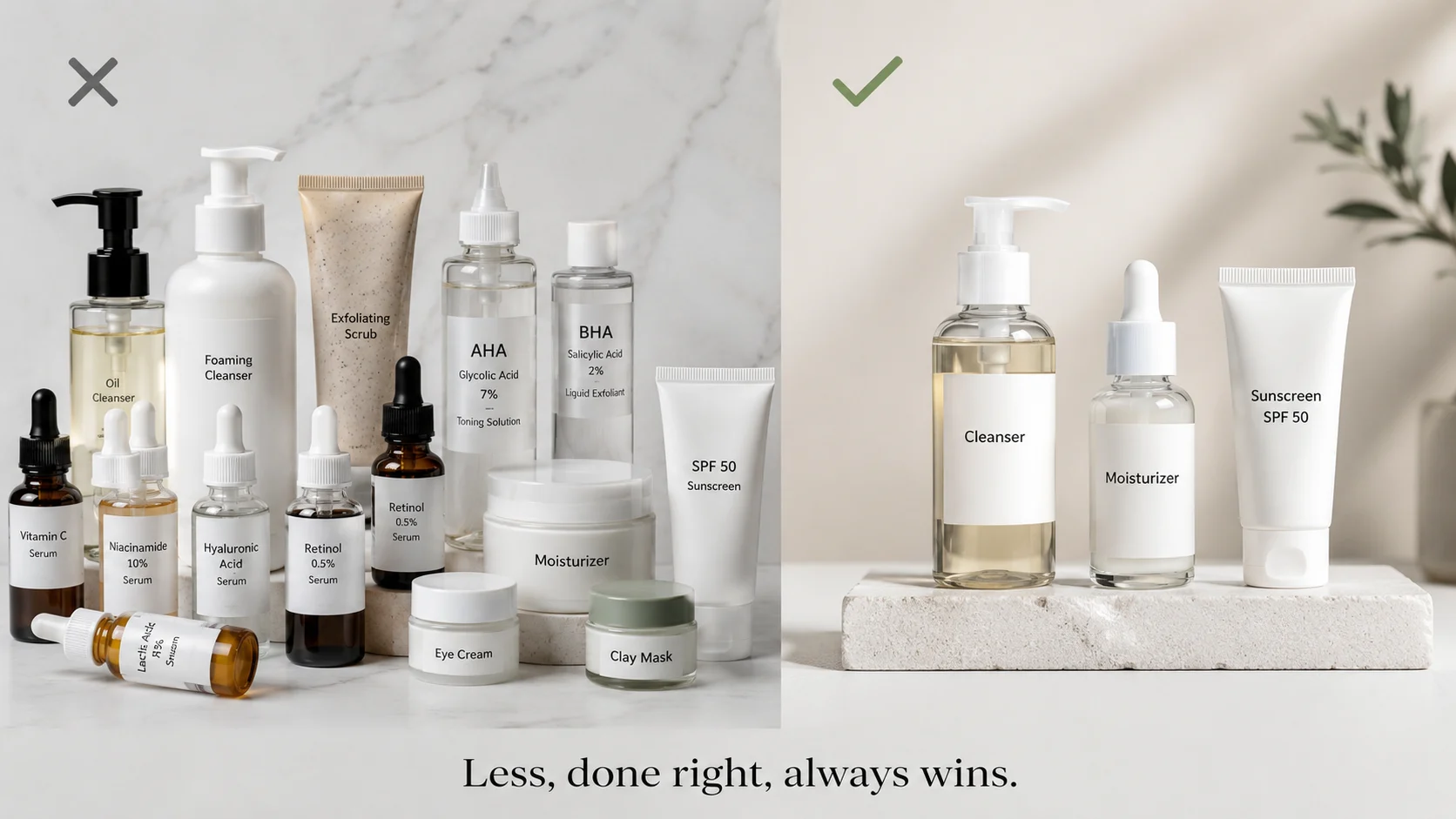
Your bathroom shelf has more products than most clinics. You've watched the tutorials. You follow the dermatologist reels. You own the glycolic toner, the vitamin C serum, the retinol, the niacinamide, and at least two different SPFs. And yet - your skin is redder than it was six months ago, more sensitive, more breakout-prone, and reacts furiously to things it once tolerated without complaint.
Here is the uncomfortable truth that the skincare industry profits enormously from not saying clearly: the most common cause of unexplained skin sensitivity, persistent redness, and barrier dysfunction in urban working professionals today is not lack of skincare. It is too much of it - applied in the wrong order, at the wrong frequency, without any understanding of how the ingredients interact.
This is what clinicians are increasingly calling post-actives burnout or skin barrier crisis - a state where the cumulative assault of well-intentioned but poorly sequenced products has eroded the skin's fundamental protective architecture. Skin specialists across India are seeing it in consultation after consultation: educated, thoughtful, health-conscious people whose skin has become chronically inflamed not because they ignored it, but because they attended to it - obsessively, misguidedly, guided by algorithm rather than science.
This is not a criticism. The information environment that surrounds skincare today is genuinely confusing. A confident influencer with 800,000 followers shows you her seven-step morning routine, and each product has peer-reviewed research behind it - in isolation. What she doesn't show you is what those seven products do to each other, to your specific skin type, in Bangalore's climate, over four months. That is clinical knowledge, not content.
A 2025 Indian research study found that 87.5% of social-media-influenced skincare users reported experiencing side effects from their routines. Of those, only 4.1% sought a doctor's consultation. The rest kept going, added more products, tried harder - and made the damage worse.
This blog is an attempt to close that gap - to explain what the skin barrier actually is, what damages it, how to recognise the damage, and what the path back to healthy, functional skin actually looks like.
The Foundation
Your Skin Barrier:
The Wall Nobody Told You About
Before we can understand what goes wrong, we need to understand what exists before anything goes wrong. The skin barrier - technically the stratum corneum, the outermost layer of the epidermis - is not simply a passive covering. It is an actively maintained, biochemically complex structure whose job is both protective and communicative.
Think of it as a brick wall where the bricks are dead skin cells (corneocytes) and the mortar between them is a precise lipid matrix made up primarily of ceramides, cholesterol, and fatty acids. This mortar determines everything: how much moisture your skin retains, how much pollution, bacteria, and allergens penetrate, and how reactive your skin is to the topical products you apply.
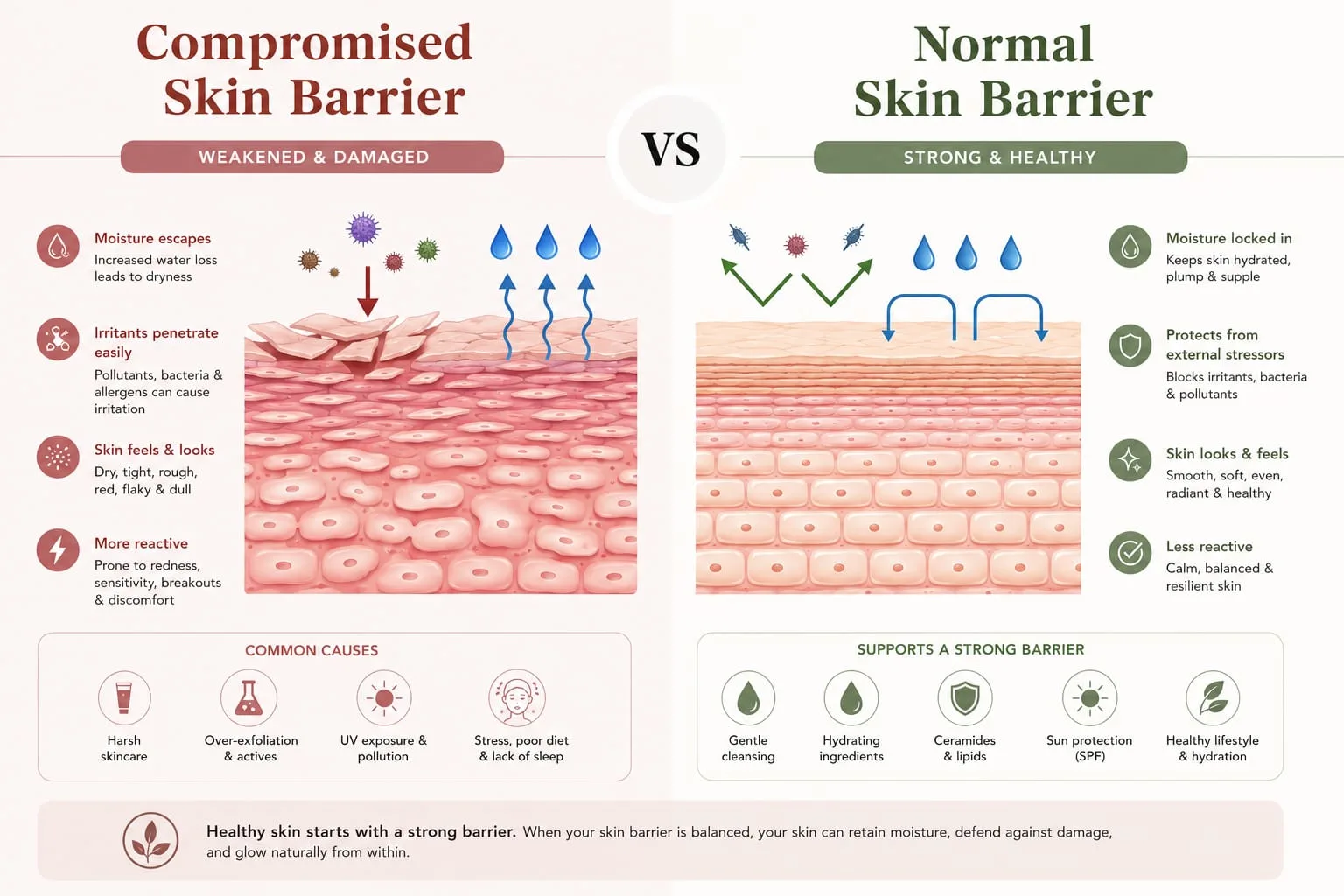
When the barrier is intact, the skin is calm, hydrated, even-toned, and resilient. Products absorb effectively. Breakouts heal faster. UV and pollution cause less lasting damage. In short, every other skincare goal you have - anti-ageing, brightening, acne control - depends on a functional skin barrier as its prerequisite.
When the barrier is compromised, the opposite holds. Water evaporates faster (a process measured clinically as transepidermal water loss, or TEWL), irritants penetrate more easily, the skin's immune response is on constant low-grade alert, and paradoxically, every product you apply - including the ones marketed as "nourishing" - stings more, absorbs poorly, and sometimes worsens the problem.
"The skin barrier is not a surface. It is a biological system - and like any system under sustained overload, it eventually fails in ways that cannot be fixed by adding more."
- A principle every aesthetic clinician learns to recognise across consultation after consultationThe critical insight here is this: actives work by temporarily disrupting the barrier. Retinoids accelerate cell turnover, meaning they shed the protective outer layer faster. AHAs dissolve the bonds between dead cells, thinning that layer. Vitamin C at high concentrations is acidic and mildly irritating by design. When used correctly - at the right concentration, frequency, and with adequate recovery time - these disruptions are productive. The skin repairs, rebuilds, and emerges stronger.
When used aggressively, in combination, and without recovery time - which is precisely what many multi-step influencer routines demand - the barrier breaks down faster than it can rebuild. The disruption stops being productive and becomes chronic. You have entered post-actives burnout territory.
The Six Culprits
What Is Actually Damaging
Your Skin Barrier
Over-treatment rarely arrives as a single dramatic mistake. It is almost always the accumulation of individually understandable choices, each one reinforced by social media, product marketing, or a well-intentioned recommendation. Here are the six most common pathways to barrier burnout - and the thinking patterns that sustain them.
Retinol Overuse & Retinol Burn
Retinol is genuinely one of the most well-evidenced anti-ageing ingredients in skincare. It is also one of the most aggressively over-applied. The science recommends starting at 0.025-0.05% concentration, two nights per week, for 6-8 weeks before increasing frequency. The influencer environment, however, normalises 0.5-1% retinol used nightly from week one. The result is a constellation of symptoms - persistent peeling, tight redness, sensitivity to previously tolerated products, and paradoxically, increased breakouts - that many people misread as "purging" and continue to push through. It is not always purging. It is often barrier damage.
Acid Overload - The AHA/BHA Layering Trap
Glycolic acid, lactic acid, mandelic acid, salicylic acid - these chemical exfoliants are sold in everything from toners to cleansers to sheet masks and serums. People who use a glycolic acid toner morning and evening, a BHA serum at night, and an acid-based cleanser daily are applying chemical exfoliation three to six times per day. This strips the lipid mortar from the skin barrier at a rate it cannot replenish. The early sign is a kind of shiny, tight, almost lacquered appearance - which many people mistake for "clean, clear skin" before the redness, flaking, and sensitivity begin.
Layering Incompatible Actives Together
The interaction between ingredients matters enormously - and most skincare packaging says nothing about it. The most problematic combinations include: retinol with high-concentration AHAs (both aggressive cell-turnover agents, both barrier disruptors - stacking them amplifies irritation, not results); vitamin C serum (L-ascorbic acid, pH 2.5-3.5) immediately followed by retinol (which deactivates at low pH, losing efficacy while the skin receives the irritation of both); and multiple niacinamide and vitamin C products (which can react to produce a yellow-tinting niacin compound). Using these together does not produce better outcomes. It produces more damage on the same disrupted barrier.
At-Home Devices Without Professional Guidance
Derma rollers, LED masks, microcurrent devices, at-home chemical peel kits, and facial scrubbing devices have become mainstream, with major e-commerce platforms shipping them without any instruction on contraindications, frequency, or how to combine them with an already-active skincare routine. A derma roller used weekly on skin that is already acid-toned daily is applying dual mechanical and chemical trauma to the same compromised surface. At-home laser and IPL devices present their own set of risks on Indian skin types (Fitzpatrick III-V), where improper settings or frequency can cause post-inflammatory hyperpigmentation that is far harder to resolve than the concern being treated.
Routine Hopping - Constant Product Switching
The content machine runs on newness. Every week there is a new ingredient declared transformative, a new brand claimed superior, a new "viral" routine that promises glass skin in 10 days. The result for many urban professionals is a constant churn of new products being introduced without adequate testing periods. The skin needs a minimum of 6-8 weeks with a stable product set to show accurate response. Introducing new products every two to three weeks means the skin is perpetually in an adjustment phase - and when something reacts, nobody knows which product caused it, so more products are added to manage the reaction.
Climate Incompatibility - Routines Built for Western Skin in Western Weather
The vast majority of skincare content is created in temperate climates - the UK, the US, South Korea - for skin types that typically sit at the drier, less melanin-rich end of the spectrum. Bangalore's climate is warm, humid, and UV-intense year-round. Routines that include heavy occlusives, thick creams, and high-frequency exfoliation are appropriate for cold, dry environments. In Bangalore's heat, they clog pores, increase sebum oxidation, and accelerate barrier inflammation. Additionally, darker skin types (Fitzpatrick III-VI, which describes most Indian skin) are significantly more prone to post-inflammatory hyperpigmentation - meaning any irritation or inflammation from over-treatment leaves a mark that can persist for months to years.
Recognise the Crisis
Eight Signs Your Skin Barrier
Is in Distress
Skin barrier damage is not always dramatic. It often announces itself gradually, through signals that are easy to misread as reasons to use more products rather than fewer. Here is what to look for:
Stinging With Products That Didn't Before
When your regular moisturiser, vitamin C, or even water-based products start to sting, the barrier is not protecting the nerve endings in the dermis. This is a reliable early sign of barrier compromise.
Tight, Dehydrated Feeling Despite Moisturising
If your skin feels tight and parched despite applying moisturiser twice daily, the barrier's capacity to retain that moisture has been disrupted. Topical hydration does not substitute for a functioning lipid barrier.
Persistent Redness or Flushing
Chronic low-grade redness - not a reaction to a specific product, but a baseline state - indicates that the skin's inflammatory signalling is in constant activation due to repeated barrier assault.
Suddenly Reacting to Products You've Used for Months
A product you've tolerated for six months now causes redness? The product has not changed - your barrier has. Sensitisation happens when the barrier is no longer screening irritants adequately.
Breakouts in New Patterns or New Locations
Breakouts appearing in unusual places - or an acne pattern that wasn't there before starting a new routine - often signals barrier disruption allowing bacterial penetration, rather than intrinsic acne activity.
Waxy or "Tight Glass" Appearance
Over-exfoliated skin develops a distinctive tight, shiny, almost waxy look - often mistaken for "clear, glowing" skin before the irritation cycle sets in. If your skin looks polished but feels uncomfortable, it has been stripped.
Dull, Grey or Uneven Tone That Wasn't There Before
A damaged barrier accelerates pigmentation irregularities, particularly in Indian skin types. Dullness and patchy tone that appears after starting a new routine often indicates inflammatory PIH from barrier damage, not an original pigmentation concern.
The "Nothing Is Working" Feeling
If you feel that no product improves your skin and every new addition makes it worse, your skin's absorption and repair mechanisms are disabled. The barrier needs recovery before any active ingredient can function properly.
The Vicious Cycle
The Overtreatment Trap:
Why More Products Make It Worse
There is a particular cruelty to post-actives burnout: its symptoms look, on the surface, like skin that needs more intervention. Redness looks like it needs a serum. Breakouts look like they need a treatment. Dullness looks like it needs an exfoliant. The instinct to reach for another product - to solve the problem with the same category of action that caused it - is almost universal.
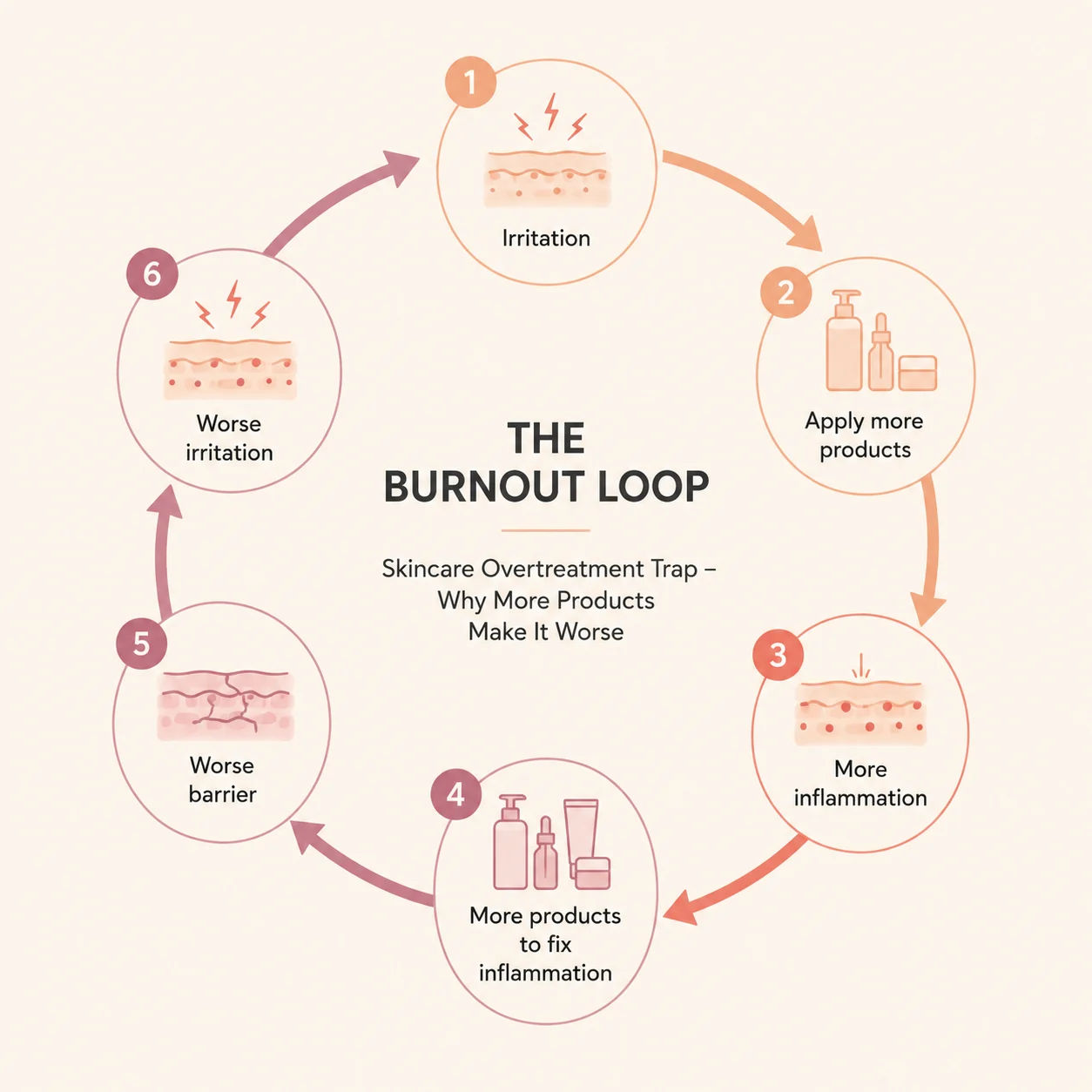
This is the trap. A 2024 clinical review noted that one of the most commonly mismanaged presentations in aesthetic dermatology is precisely this: patients who have been treating worsening symptoms with additional actives, progressively deepening the barrier damage in pursuit of results that cannot arrive on a broken foundation.
The counterintuitive reality is this: a skin barrier that has been chronically disrupted cannot respond normally to any active ingredient. Retinol cannot stimulate collagen if the cells it targets are in constant inflammatory alert. Vitamin C cannot brighten if the skin is spending all its repair capacity on inflammatory signalling. Chemical exfoliants cannot improve texture if the skin is already stripped raw. Every product you apply onto a compromised barrier either does nothing, irritates, or - in the case of acid-based products - actively continues the damage.
Recovery begins not by adding, but by radically simplifying.
Indian skin (Fitzpatrick III-VI) carries a higher baseline risk from over-treatment than lighter phototypes. Two reasons: first, melanocyte activity in darker skin is more easily triggered by inflammation - so any barrier disruption is more likely to leave a post-inflammatory hyperpigmentation (PIH) mark. Second, most skincare content is calibrated for temperate climates and lighter skin - the frequencies, concentrations, and combinations that "work" in a Western tutorial may be clinically inappropriate for Indian skin in Bangalore's climate. If you've been following international influencer routines faithfully and your Indian skin keeps reacting - this is likely why.
First Response
The Recovery Protocol:
What to Do at Home, Right Now
If you recognise your skin in the warning signs above, the protocol below is not a product recommendation - it is a philosophy of radical simplification. The goal is to give your barrier the conditions it needs to rebuild its lipid matrix. This takes time - typically 4 to 8 weeks for moderate damage - and it requires resisting the impulse to accelerate recovery with more products.
The golden rule of barrier recovery: If you are not certain a product is helping, it is almost certainly interrupting the healing process. During recovery, the default is to remove, not add.
| Step | What to Do | What to Avoid |
|---|---|---|
| Cleansing | One gentle, pH-balanced cleanser (no foam, no sulphates). Use once daily in the evening only - plain water in the morning. | Exfoliating cleansers, micellar water with alcohol, cleansing brushes or devices, double-cleansing with oil + foaming cleanser. |
| Active Pause | Stop all actives completely: retinol, AHAs, BHAs, vitamin C, benzoyl peroxide. No exceptions, even at "low" concentrations. Your skin cannot distinguish between low-dose and high-dose irritation on a broken barrier. | Retinoids of any strength, glycolic/lactic/mandelic/salicylic acid, ascorbic acid serums, physical scrubs, clay masks. |
| Barrier Support | A single moisturiser containing ceramides, fatty acids, and/or cholesterol. Apply to slightly damp skin. This is your most important product. Fragrance-free is non-negotiable during recovery. | Fragranced creams, products with essential oils, anything with more than 8-10 ingredients. Simpler is better. |
| Sun Protection | A gentle mineral SPF (zinc oxide or titanium dioxide) every morning. Your compromised barrier offers reduced UV protection, and UV exposure will both deepen the barrier damage and worsen any PIH. | Chemical SPF filters (some can irritate sensitised skin). Avoid SPF in a formulation with active ingredients or fragrance. |
| Hydration Support | A plain hyaluronic acid serum (one or two molecular weights, unfragranced) under your ceramide moisturiser can help if dryness is significant. Optional - the ceramide moisturiser alone is sufficient for most. | HA products with added niacinamide (introduce separately later), serums with multiple actives, peptide-heavy serums during acute recovery. |
| Recovery Duration | Aim for a minimum of 4 weeks on this stripped-back routine before assessing. Significant barrier damage may take 8-12 weeks. Introduce actives one at a time, at the lowest concentration, every other night, only after recovery is confirmed. | Trying to rush recovery. Reintroducing multiple actives at once. Switching moisturisers during the recovery window. |
It is worth acknowledging directly: for many people who have built a complex skincare identity around their products and routines, this simplification is genuinely difficult. The urge to "do something" is powerful. What you are doing, in the recovery phase, is making space for your skin to do what it evolved to do - heal itself - by removing the obstacles.
Beyond the Home Protocol:
When Skin Needs Clinical Recovery
For many cases of moderate to severe barrier burnout, home-based simplification is necessary but not sufficient. When the barrier has been significantly compromised - particularly when inflammation has been chronic, when post-inflammatory hyperpigmentation has set in, or when the skin has become so reactive that even barrier-repair products cause stinging - professional aesthetic treatment can meaningfully accelerate recovery, address secondary damage, and restore what topical products alone cannot.
The following treatments are available at Krity 360 and are clinically appropriate at different stages of barrier recovery and post-burnout repair. Unlike the actives that caused the damage, these are administered with precise dosing, appropriate sequencing, and professional monitoring.
HydraFacial Treatment
When barrier damage has left the skin congested, dull, and dehydrated simultaneously, HydraFacial offers deep-layer cleansing, gentle non-acid exfoliation, and simultaneous infusion of hyaluronic acid and antioxidants - without the irritation of manual extraction or acid exfoliants. For over-treated skin, it provides the hydration infusion and pore clearing the compromised barrier cannot achieve on its own, with zero downtime. An excellent starting point in the clinical recovery journey.
Explore HydraFacialMedifacial Treatment
A clinically designed treatment customised to your skin's specific state - not a standard facial, but a protocol chosen by a skin professional after assessment. For post-actives burnout, a medifacial can be formulated to provide anti-inflammatory actives, barrier support ingredients, and LED light therapy to calm the chronic inflammatory state that over-treatment has created. Its defining advantage is precision: your skin at this stage is reactive and individual, and a generic treatment is the last thing it needs.
Explore MedifacialCalibrated Chemical Peels
This requires an important caveat: the acids that over-enthusiastic home routines use as daily actives are the same family of ingredients used in professional chemical peels - but administered at precise concentrations, proper pH levels, and appropriate intervals by a trained clinician. When post-inflammatory hyperpigmentation has set in from over-treatment, a correctly selected peel (mandelic acid peels are particularly well-suited to Indian skin types, offering efficacy with minimal irritation risk) can accelerate PIH resolution once the acute barrier inflammation has calmed. This is a later-stage intervention, not a first response.
Explore Chemical PeelsMicroneedling
Once the acute barrier inflammation has resolved (typically 6-10 weeks into recovery), microneedling - controlled micro-injury to stimulate collagen and elastin synthesis - is one of the most effective tools for restoring the dermal architecture that sustained over-treatment has thinned. Texture irregularities, enlarged pores, fine lines that appeared or worsened during the burnout phase, and mild scarring from inflammation-triggered breakouts all respond well to a structured microneedling protocol. When combined with barrier-supportive serums rather than aggressive actives at the time of treatment, it rebuilds rather than assaults.
Explore MicroneedlingSkin Boosters
Post-actives burnout depletes the dermis of moisture at a level that topical creams cannot reach. Skin boosters - micro-injected hyaluronic acid, vitamins, antioxidants, and minerals delivered directly into the mid-dermis - restore the structural hydration that the skin's natural production cannot keep pace with after months of barrier damage. The improvement in skin suppleness, radiance, and tone is typically visible within two to three weeks of the first session, and lasting 6-12 months with appropriate maintenance. This addresses the root dehydration that over-treatment creates, not just its surface expression.
Explore Skin BoostersPRP / GFC Skin Therapy
Platelet-Rich Plasma and Growth Factor Concentrate - produced from your own blood - deliver a concentrated payload of the body's own healing signals directly to the skin. For post-burnout skin where the fibroblast activity that should repair the dermal matrix has been suppressed by chronic inflammation, GFC therapy provides the targeted biological trigger for repair that no topical product can replicate. The treatment stimulates collagen production, reduces inflammation, and accelerates tissue remodelling - addressing the underlying damage, not its cosmetic expression. A series of 3-4 sessions typically produces visible improvement in skin quality, texture, and resilience.
Explore PRP & GFCExosome Therapy for Skin
At the frontier of regenerative aesthetics, exosome therapy delivers cell-signalling nanoparticles that carry regenerative instructions directly to damaged skin cells. For skin that has been severely or chronically over-treated - where conventional approaches produce limited response - exosomes activate repair programmes at a cellular level, stimulate collagen synthesis, reduce the inflammatory cytokines that sustain barrier damage, and accelerate the skin's return to baseline function. Cell-free, low-reactivity, and requiring fewer sessions than GFC, this is the appropriate intervention when the depth of damage is significant and conventional approaches have not produced adequate recovery.
Explore Exosome TherapyIV Drip Therapy
When chronic over-treatment has driven systemic oxidative stress - as it often does in high-achieving professionals who are simultaneously managing demanding work lives - targeted IV therapy delivers vitamin C, glutathione, B-complex vitamins, zinc, and selenium at bioavailabilities oral supplementation cannot match. For skin that is both barrier-compromised and systemically depleted, IV therapy provides the nutritional substrate that skin cell renewal and barrier lipid synthesis require. It complements topical and aesthetic interventions by ensuring the body's repair mechanisms have what they need to work effectively.
Explore IV Drip TherapyA word on sequencing: The treatments above are not all appropriate simultaneously, or at the same stage of recovery. HydraFacial and Medifacial are excellent first-line clinical interventions for acutely over-treated skin. Microneedling and GFC are most effective once acute inflammation has resolved. Exosome therapy and Skin Boosters can be used at various stages depending on the assessment. A consultation at Krity 360 will map this sequence appropriately to your skin's current state, not a generic protocol.
What Over-Treatment Does to Your Hair:
The Connection Most People Miss
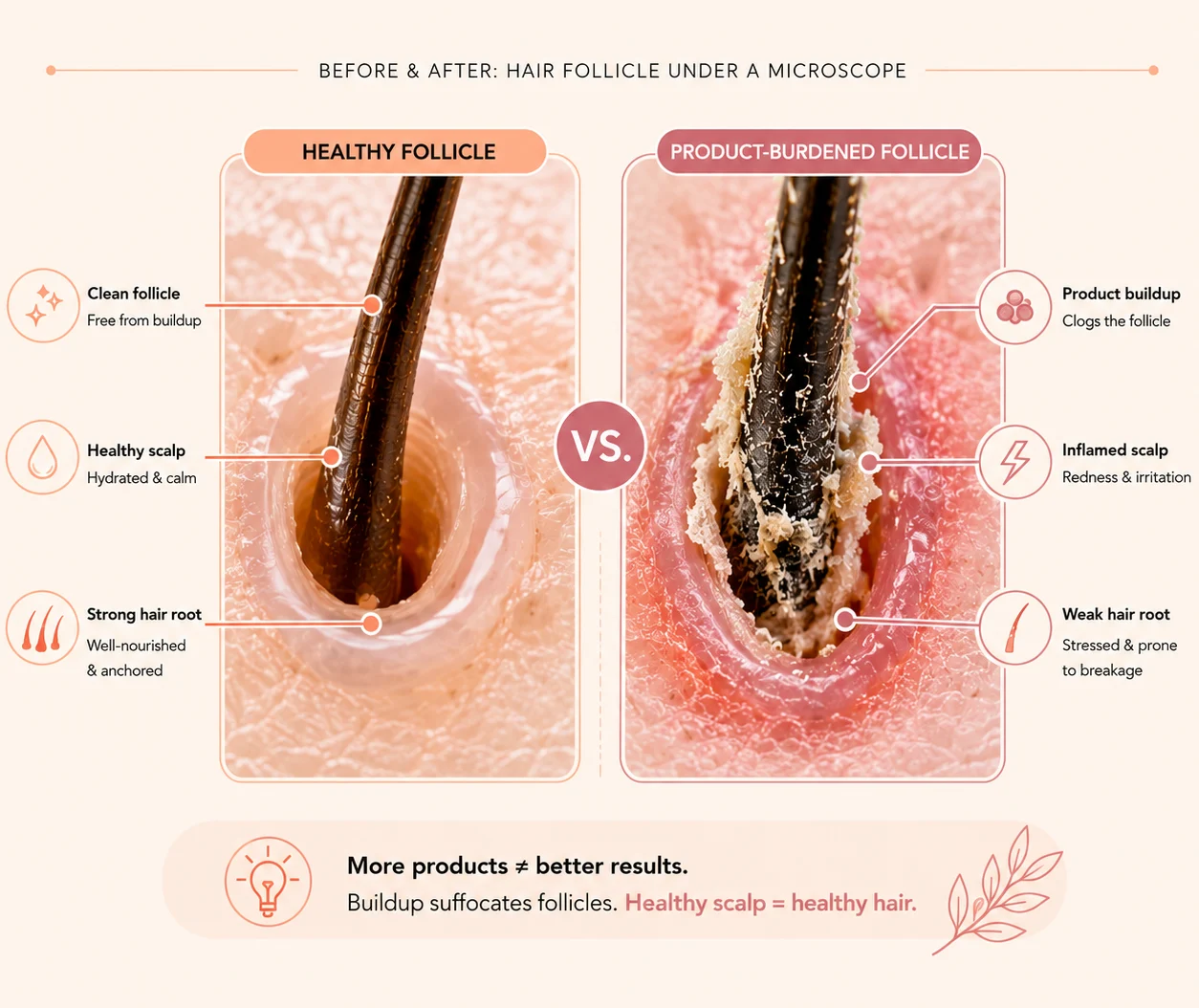
Skin barrier over-treatment rarely exists in isolation. The same cultural forces driving the overuse of facial actives - influencer content, viral product recommendations, the idea that more aggressive equals more effective - play out identically in the hair and scalp space. And the consequences can be even harder to reverse, because hair follicle health has a slower feedback loop than skin.
The scalp is skin. Specifically, it is one of the most complex and densely innervated areas of skin on the body, with a significant microbiome of its own and a direct anatomical connection to the hair follicles nested within it. When the scalp's own barrier is disrupted - through over-clarifying shampoos used daily, exfoliating scalp treatments layered with anti-dandruff actives layered with scalp serums, or DIY oil treatments that occlude follicles - the consequences include chronic scalp inflammation, follicle-level irritation, disrupted scalp pH, and altered microbiome composition. All of which contribute to hair that thins, breaks, grows slowly, or fails to grow at all.
The specific problem profile most commonly seen in urban professionals:
- Scalp product overload Layering a scalp serum over a scalp tonic over a scalp scrub, on the same day, is the scalp equivalent of a multi-active facial routine. The scalp absorbs products readily, and its barrier is no less susceptible to disruption than facial skin.
- Clarifying shampoo misuse Clarifying shampoos are designed for occasional use to remove build-up. Used as a daily or even weekly cleanser, they strip the scalp's natural sebum - the lipid barrier equivalent - creating scalp dryness, flaking, and reactive sebum overproduction that is then misidentified as "oily scalp" and treated with more clarifying product.
- DIY scalp treatments from content Onion juice, apple cider vinegar rinses, raw egg masks, and high-concentration essential oil blends are being applied to scalps at concentrations and frequencies that cause contact dermatitis, follicular inflammation, and in some cases direct chemical irritation to follicles - all of which impede rather than support hair growth.
- Biotin and supplement excess The supplement industry around hair growth has produced a generation of urban consumers taking multiple biotin, collagen, and hair supplement products simultaneously - often without addressing the actual causes of hair thinning (iron deficiency, thyroid function, hormonal shifts, or diet). Excess biotin in particular is documented to interfere with certain lab tests, and its benefit is limited to those who are actually biotin-deficient.
For hair concerns that have been driven by or complicated by over-treatment - including scalp inflammation, hair thinning associated with scalp health issues, and texture damage from chemical over-processing - clinical hair restoration treatments offer targeted solutions that work with the follicle's biology rather than overloading it:
GFC Hair Therapy
Growth Factor Concentrate derived from your own platelets delivers targeted biological signals to compromised and miniaturised follicles - restoring their metabolic activity and reversing the dormancy that chronic scalp inflammation can induce.
Explore Hair GFCExosome Hair Restoration
For scalps with prolonged inflammation history, exosome therapy modulates the inflammatory environment at the follicle level - addressing the root biological cause of inflammation-driven hair thinning rather than treating the symptom.
Explore Hair ExosomeHair Mesotherapy
Direct micro-injection of a precisely calibrated nutrient cocktail into the scalp dermis restores the microenvironment around follicles - bypassing the absorption limitations that leave topical scalp products working only on the surface.
Explore Hair MesotherapyGoing Forward
Rebuilding Your Routine:
Principles That Actually Work
Once recovery is underway - and this is a question best answered in consultation, not by a calendar - the goal is not to return to the overcrowded shelf. The goal is to build a routine that is intentional, minimal, evidence-aligned, and adapted to your actual skin type, not an influencer's skin type.
The Four Non-Negotiables for Any Sustainable Routine
1. One active at a time, introduced slowly. Retinol, vitamin C, AHAs, niacinamide - each is legitimate. Used together, daily, from the beginning, they are a formula for barrier damage. Introduce one active. Use it two to three times per week. Wait six weeks before assessing and adjusting. Then - and only then - consider adding another, with professional guidance on compatibility.
2. SPF is not optional - it is the active ingredient that protects every other investment. No brightening serum, no anti-pigmentation treatment, no collagen-stimulating product achieves its potential on skin that is daily exposed to UV without protection. In Bangalore's UV Index of 8-12, this means a minimum SPF 30 PA+++ every morning, reapplied after 3-4 hours if outdoors.
3. Product count is inversely related to skin stability. The skin's barrier maintenance is a biological process. Every product it must contend with is a variable it must manage. Three to five well-chosen products, used consistently over months, will produce better outcomes than twelve products cycled in and out monthly. Stability is underrated.
4. When in doubt, see someone who is looking at your actual skin - not your screen. The democratisation of skincare information is broadly positive - but dermatological decisions are still individual. Your skin type, your pigmentation level, your hormonal profile, your local climate, and your stress load all affect how your skin responds to any given ingredient or treatment. A single consultation with a skin professional is worth more than twenty tutorials.
What People Ask Most Often
Common questions from clients navigating this issue, answered plainly.
Your Skin Deserves an Expert Eye - Not Another Product
A consultation at Krity 360 gives you a clear, honest assessment of your skin's current state, an understanding of what's driving the problem, and a protocol that begins with recovery - not another serum.
Krity 360 | 34/5, Aadeshwar Chambers, Kasavanahalli Main Road, 1st Cross Road, Bengaluru, Karnataka 560035 | +91 93807 89495